

5 Certifications Every Starch Manufacturer Should Have Before You Buy
Buying starch is not simply about comparing prices or selecting the nearest supplier. For industries that depend on starch as a key raw material, quality and consistency influence every stage of production. A small variation in raw materials can affect processing efficiency, product performance, and customer satisfaction. This is why successful businesses pay close attention to certifications before selecting starch manufacturers.
Certifications act as proof that a manufacturer follows recognised systems to maintain quality, safety, and consistency. They also show that the company invests in standardised manufacturing practices instead of relying only on routine production. Whether you are sourcing starch for food processing, textiles, pharmaceuticals, paper, or industrial applications, understanding these certifications can help you choose a trusted manufacturing partner.
Why Certifications Should Be Part of Your Buying Decision
Many buyers focus only on product specifications, but certifications provide another layer of confidence. They indicate that manufacturing processes are regularly monitored, documented, and continuously improved.
Certified starch manufacturers are generally better prepared to maintain consistent product quality, reduce production errors, and respond effectively to customer requirements. For businesses looking for long-term suppliers, certifications often become an important part of supplier evaluation.
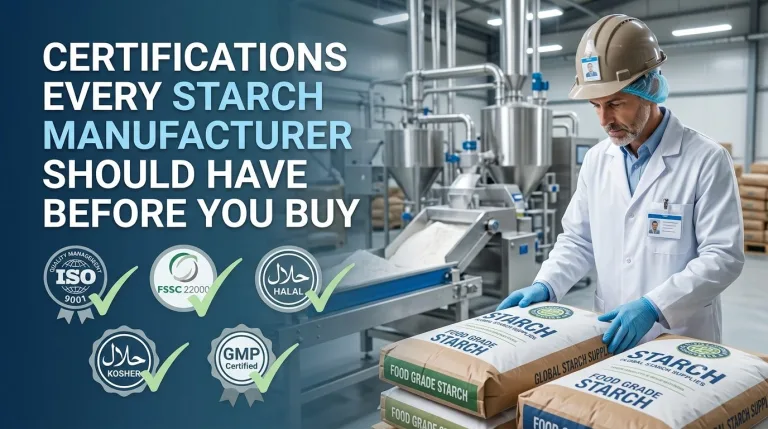
ISO 9001 Shows Commitment to Consistent Quality
ISO 9001 is one of the most widely accepted quality management certifications in the manufacturing industry. Rather than focusing on a single product, it evaluates how a company manages its entire production process.
Manufacturers operating under ISO 9001 follow structured procedures for quality checks, documentation, employee training, and process improvement. This helps ensure that customers receive products with consistent performance across every order.
When comparing different starch manufacturers, ISO 9001 reflects a company’s commitment to maintaining organised and reliable manufacturing practices.
Food Safety Certifications Build Customer Confidence
Businesses supplying food manufacturers should always verify whether their suppliers follow internationally recognised food safety standards.
Food safety certifications demonstrate that proper hygiene practices, contamination prevention measures, and traceability systems are followed throughout production.
These standards help manufacturers produce food-grade starch that supports quality expectations across dairy products, bakery items, confectionery, snacks, sauces, beverages, and other processed foods.
For food businesses, working with certified starch manufacturers helps strengthen confidence throughout the supply chain.
GMP Reflects Controlled Manufacturing Standards
Good Manufacturing Practices focus on creating a disciplined production environment where every activity follows approved procedures.
This includes equipment maintenance, employee hygiene, production monitoring, cleaning schedules, documentation, and quality inspections.
Instead of depending only on end product testing, GMP encourages quality at every stage of manufacturing.
For industries requiring dependable raw materials, GMP-certified starch manufacturers demonstrate greater attention to operational discipline and manufacturing consistency.
HACCP Supports Preventive Quality Management
Hazard Analysis and Critical Control Points is a preventive system that identifies possible risks before they become production problems.
Rather than correcting issues after manufacturing, HACCP encourages manufacturers to identify critical control points where quality and safety can be monitored throughout the process.
This approach improves production reliability while reducing avoidable risks.
Many businesses prefer starch manufacturers that implement preventive quality systems because they contribute to better process control and dependable product performance.
Export Compliance Demonstrates Global Readiness
Companies serving international customers must satisfy additional quality expectations beyond domestic requirements.
Export compliance involves maintaining product documentation, traceability, customer specifications, packaging standards, and regulatory requirements for different markets.
Manufacturers with export experience often develop stronger quality systems because they regularly meet diverse customer expectations across multiple countries.
For businesses planning international sourcing, choosing experienced starch manufacturers with export capabilities supports smoother business operations.
Certifications Are Valuable, but Experience Matters Too
While certifications provide confidence, buyers should also evaluate practical business strengths before making a decision.
Look for manufacturers with technical expertise, reliable production capacity, application knowledge, responsive customer support, and the ability to maintain long-term supply commitments.
An experienced manufacturer understands how different industries use starch and can recommend products that suit specific production requirements.
Combining certifications with technical knowledge creates stronger business partnerships.
How SPAC Starch & Derivatives Supports Industrial Buyers
Choosing the right manufacturing partner involves more than checking certificates. Businesses also need dependable service, consistent supply, and application-focused solutions.
SPAC Starch & Derivatives supplies starch products for industries including food processing, textiles, pharmaceuticals, paper, adhesives, and packaging. Every product is developed with attention to quality, consistency, and industrial performance to support changing manufacturing requirements.
Explore our complete product range on the Products page
For application-specific solutions, visit our Carboxy Methyl Starch , Cationic Starch , and Yellow Dextrin Starch pages.
To learn more about our manufacturing expertise and company values, visit the About Us page.
Conclusion
Specialised starch has evolved from being a simple industrial ingredient into a high-performance manufacturing solution. Its ability to improve product quality, production efficiency, and application-specific performance makes it an essential component across industries such as textiles, pharmaceuticals, food processing, paper, adhesives, and packaging.
Choosing the right starch grade is important, but selecting the right supplier is equally critical for long-term success. SPAC Starch & Derivatives continues to support businesses with dependable starch solutions that meet the highest quality standards. As one of the trusted Starch suppliers in India, the company remains committed to delivering innovation, consistency, and reliable solutions for manufacturers across diverse industries.