

Why Are Your Tablets Failing Disintegration Tests? Common Pharma-Grade Starch Binder Problems
A batch fails disintegration testing right before release. Nothing in the formulation changed, compression settings are identical to the last successful run, and yet the tablets won’t break down within the pharmacopoeia limit. In our experience working with formulation teams, this pattern points to one place more often than any other: the starch excipient.
Starch carries a dual load in most tablet formulations; it acts as a binder during granulation and as a disintegrant during dissolution. When the starch is inconsistent in particle size, moisture, or grade, that dual function breaks down quietly, and the failure only shows up downstream, at QC. This guide covers why that happens, how to diagnose it, and what to verify in your starch supply before your next batch reaches the lab.
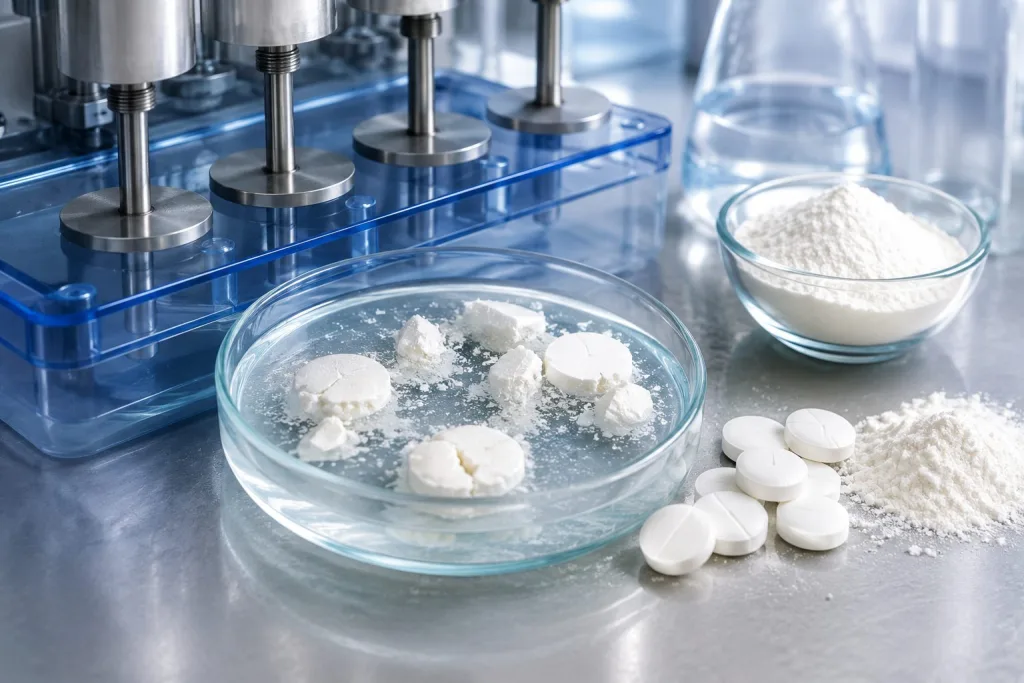
What a Disintegration or Friability Failure Actually Costs You
Under USP <701>, uncoated tablets must fully disintegrate within 15 minutes in the test apparatus, with tighter or looser limits set for specific dosage forms (sublingual, effervescent, delayed-release) by the individual monograph. Friability, under USP <1216>, is generally expected to stay under 1% weight loss for the tested sample. (These figures reference the published USP general chapters, not proprietary SPAC lab data.) IP and BP apply parallel disintegration and friability tests with their own monograph-specific limits, so the exact figure that applies always depends on the dosage form and the pharmacopoeia your product is registered against.
A failure on either test rarely stays contained to the lab result:
- Reworked or scrapped batches directly increase material and labor cost, on top of API and coating cost already sunk
- Delayed release schedules that compound if the root cause isn’t caught on the first investigation
- Compliance exposure: repeat failures on the same product draw closer scrutiny in the next audit cycle
- Diagnostic time cost: teams often adjust compression force or coating parameters first, when the root cause traces back further upstream, to the excipient itself.
A representative case pattern
This is a pattern seen across the industry: a formulation passes disintegration testing consistently for months, then fails two batches in a row right after a starch lot switch to a new source. Compression settings, humidity logs, and coating parameters are unchanged. The investigation traces back to a shift in the starch’s particle size distribution between lots, invisible on a basic grade-name comparison, but enough to change how the excipient swells on contact with dissolution fluid. It’s the pattern worth ruling out early, before reworking the process itself.
Once you’ve confirmed you’re looking at the right product, the next question is usually who to actually buy from: a manufacturer, a supplier, or an exporter, each of which plays a different role in getting starch to your business.
5 Root Causes Tied to Starch Binder Quality
Here’s where the real mix-up happens, and it’s worth separating clearly. Corn starch (or maize starch) is a fine, powdery extract used mainly as a thickening agent. Corn flour, on the other hand, means different things in different countries.
In the US, “corn flour” is often used interchangeably with corn starch. In India, “maize flour” is a completely different product: a coarser, whole-grain flour made by grinding the entire kernel, used for rotis and traditional baking, not for thickening sauces or gravies.
Understanding this corn flour vs corn starch distinction and the broader corn starch vs cornflour difference matters because using the wrong one in a recipe or industrial process gives very different results.
1. Inconsistent particle size distribution
Particle size governs how evenly starch disperses through granulation and how predictably it swells when it meets fluid. A shift in distribution between batches, even within a supplier’s stated grade, changes disintegration behavior while every other formulation input stays constant.
2. Excess or variable moisture content
Starch is hygroscopic. Native starch used as a pharmaceutical excipient is typically expected to hold moisture in the 10–13% range; outside that band, binding strength during granulation shifts, producing tablets that are either too hard to disintegrate on time or too soft to pass friability. The exact tolerance should always be confirmed against your product’s validated specification and Certificate of Analysis.
3. Wrong binder-to-disintegrant ratio for the actual starch grade
Starch’s usefulness comes from doing both jobs at once, but only if the formulation ratio matches that specific starch’s functional profile. A supplier or lot switch, even to a starch with the same grade name, can quietly shift this balance without any visible red flag until testing.
4. Poor swelling power/gelatinization consistency
Disintegration depends on the starch swelling reliably inside the tablet matrix. Batch-to-batch variation in gelatinization behavior is one of the hardest failures to catch upstream, because it’s often invisible until dissolution testing.
5. Sourcing outside GMP-controlled conditions
Beyond functional performance, starch sourced or handled outside GMP conditions introduces both a compliance risk and an indirect risk to moisture and particle integrity before it ever reaches your facility.
USP vs IP vs BP: Why the Grade Name Isn't the Full Spec
USP, IP, and BP are separate pharmacopoeial standards issued respectively by the United States, India, and the United Kingdom, and each sets its own controls on identity, purity, moisture limits, and microbial testing for starch as a pharmaceutical excipient.
What it controls | Why it matters for disintegration | |
USP Pharma Grade Starch (US Pharmacopeia) | Identity, purity, and performance limits per US monograph | Formulations validated to USP starch may not carry over cleanly to a different monograph’s starch without re-verification |
IP Pharma Grade Starch (Indian Pharmacopoeia) | India-specific identity, purity, and quality limits | Common baseline for India-manufactured and India-market formulations |
BP Pharma Grade Starch (British Pharmacopoeia) | UK/EU-aligned identity, purity, and quality limits | Relevant for formulations targeting UK/EU-aligned regulatory pathways |
A formulation validated against one grade’s Certificate of Analysis can behave differently with a starch that technically satisfies a different pharmacopoeia’s minimum requirements but not the specific parameters the process was built around. This is why disintegration failures often appear “silently” after a supplier or grade change: nothing in the formulation changed, but the underlying excipient specification did.
Diagnostic Checklist: Is It the Starch?
Before adjusting compression force, coating, or granulation parameters, rule out the excipient first:
- Compare the current starch lot’s Certificate of Analysis against the lot used in the last passing batch
- Check particle size distribution data, not just the grade name
- Verify moisture content against your validated specification
- Confirm the binder-to-disintegrant ratio still matches this specific starch’s functional profile
- Request swelling power/viscosity data for the current lot
- Confirm GMP-compliant sourcing and current batch testing, not a one-time historical spec sheet
The Fix: Choosing and Qualifying the Right Pharma-Grade Starch
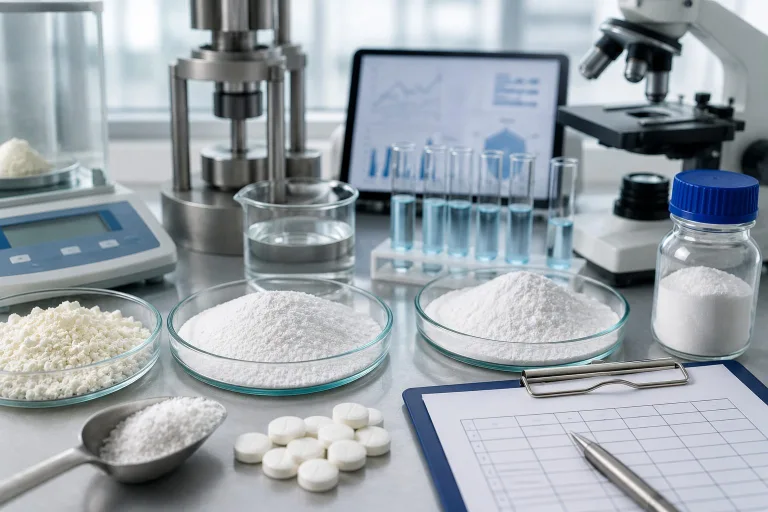
Consistent disintegration and friability results start upstream, at excipient qualification. Before locking in a starch supplier or lot, ask for:
- A full Certificate of Analysis (COA): moisture content, particle size distribution, and viscosity/swelling power, not just a grade label
- Confirmation of GMP-compliant manufacturing and in-house QC testing
- Batch-to-batch consistency data, not a single point-in-time spec sheet
- The exact pharmacopoeia grade (USP, IP, or BP) matched to what your formulation was validated against
SPAC manufactures Pharma Grade starch across USP, IP, and BP specifications, backed by in-house R&D and QC laboratories and GMP-compliant production. If disintegration or friability failures are tracing back to excipient variability, our technical team can review your formulation’s binder-disintegrant requirements and provide a Certificate of Analysis alongside your sample.
Frequently Asked Questions
What causes tablet disintegration failure?
Disintegration failure most often traces back to starch excipient inconsistency, variable particle size distribution, moisture outside tolerance, an incorrect binder-to-disintegrant ratio, or inconsistent swelling/gelatinization behavior between batches.
What is the difference between USP, IP, and BP pharma starch grades?
USP, IP, and BP are separate pharmacopoeial standards from the US, India, and the UK, respectively, each defining its own limits for starch identity, purity, moisture content, and microbial testing. A formulation validated against one grade should be re-verified, not assumed equivalent, before switching to a different grade.
How much moisture should pharma-grade starch contain?
Native pharma-grade starch is typically expected to fall in the 10–13% moisture range per general industry practice, not a USP-specific figure, though the exact tolerance should always be confirmed against your specific pharmacopoeia grade and validated formulation specification on the Certificate of Analysis.
Can a supplier change cause disintegration failures even if the starch "looks the same"?
Yes. Two starch batches can carry the same grade name yet differ in particle size distribution, swelling power, or moisture control, any of which can shift disintegration behavior without any other formulation change.
What should I request before qualifying a new starch supplier or lot?
A full Certificate of Analysis (moisture, particle size, viscosity/swelling power), confirmation of GMP-compliant manufacturing, and batch-to-batch consistency data, not a one-time historical spec sheet.
Facing repeated disintegration or friability failures?
Request a Certificate of Analysis and a sample batch of our USP, IP, or BP pharma-grade starch. 📞 +91 73731 62222 | ✉️ info@spacstarch.com